
Donate Bitcoin here


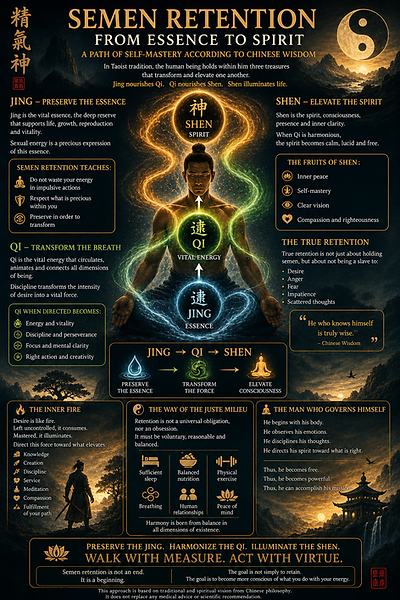

Seminal Retention — From Essence to Spirit
In the Taoist tradition, the human being is permeated by a subtle force that connects the body, breath, and spirit.
This force is often described through three treasures:
Jing — Essence
Qi — Vital Breath
Shen — Spirit
These three dimensions are not separate. They form a process of transformation: Essence nourishes Breath, Breath nourishes Spirit, and Spirit illuminates the way one lives.
From this traditional perspective, seminal retention is not simply abstaining from ejaculation. It can become a discipline intended to learn not to scatter one’s energy unconsciously, but to direct it toward a more orderly, conscious, and elevated existence.
Jing — Preserving the Essence
Jing represents, in traditional Chinese medicine and philosophy, vital Essence, associated in particular with constitution, growth, reproduction, and the fundamental reserves of the being.
Sexual energy occupies an important place in this conception.
Thus, preserving one’s essence symbolically means learning to respect what is precious within oneself.
Whenever a human being acts solely under impulse, there is a risk of scattering attention, will, and energy.
Restraint then becomes a teaching:
Do not waste what can be devoted to a greater work.
Seminal retention can be regarded as an exercise in conservation, but this conservation has meaning only if it leads to transformation.
For keeping without transforming becomes stagnation.
Qi — Transforming Essence into Movement
Qi is traditionally understood as the breath or vital energy that animates and connects the different dimensions of existence.
From a spiritual perspective, sexual discipline can become an invitation to transform the intensity of desire into vital momentum.
Desire is a force.
The question, therefore, is not:
“How can I suppress this force?”
But rather:
“Where will I direct this force?”
Toward distraction?
Toward dependence?
Or toward creation, study, work, practice, discipline, and self-improvement?
The practitioner gradually learns not to be carried away by every inner movement.
He observes.
He breathes.
He remains present.
Then he chooses.
Here, restraint ceases to be mere deprivation and becomes an exercise in inner freedom.
Shen — Elevating the Spirit
When Qi becomes more harmonious, the Taoist tradition speaks of Shen, the Spirit.
Shen represents, among other things, consciousness, mental presence, spirit, and inner clarity.
The ultimate goal is therefore not to retain indefinitely.
The goal is to transform mastery of the body into mastery of oneself, and then mastery of oneself into clarity of mind.
Is a man who cannot resist any impulse truly free?
The one who can feel desire without immediately being compelled to obey it begins to discover a new form of freedom.
The body feels.
The heart observes.
The spirit chooses.
Jing → Qi → Shen
The traditional transformation can be represented as follows:
Jing → Qi → Shen
Essence becomes Breath.
Breath becomes Spirit.
Spirit returns toward simplicity and awareness.
This progression is above all a traditional and spiritual representation, rather than a physiological description demonstrated by modern science.
Nevertheless, it offers a powerful image of the inner path:
Preserve.
Transform.
Elevate.
True Retention
True mastery does not consist merely of retaining semen.
For it is possible to retain ejaculation while leaving the mind imprisoned by fantasies, compulsions, and incessant thoughts.
True mastery is deeper.
It is learning not to be scattered.
Not to be dominated by pleasure.
Not to be dominated by anger.
Not to be dominated by fear.
Not to be dominated by impatience.
Not to be dominated by desire.
The first retention is the retention of energy.
The second is the retention of unnecessary speech.
The third is the retention of thoughts that scatter the mind.
The highest is the retention of the ego.
Thus, sexual discipline becomes a doorway toward a much broader discipline: self-mastery.
The Inner Fire
Sexual desire can be compared to a fire.
A fire left to itself consumes.
A mastered fire illuminates.
Wisdom, therefore, is not necessarily to extinguish the fire, but to learn how to contain it and use it with discernment.
Sexual strength can then symbolize a creative force.
It can be directed toward:
knowledge,
creation,
discipline,
service,
meditation,
work,
compassion,
and the fulfillment of one’s path.
The energy that yesterday served only to satisfy an impulse can tomorrow become a force in service of an intention.
The Way of the Middle Path
Any spiritual practice can become excessive when it loses its balance.
Chinese tradition places great importance on harmony and moderation.
Seminal retention should therefore not become an obsession, a source of guilt, or a belief in extraordinary powers.
It can be approached as a voluntary and conscious discipline, among other disciplines that help cultivate a more balanced life.
There is no solid scientific evidence that seminal retention automatically produces a lasting increase in testosterone, exceptional strength, or supernatural abilities.
The value of this practice, when it is beneficial, may instead lie in what it teaches:
patience, awareness, discipline, and freedom in the face of impulse.
The Man Who Governs Himself
The one who seeks mastery begins with his body.
Then he observes his emotions.
Next, he disciplines his thoughts.
Finally, he learns to direct his spirit toward what is right.
It is then that Jing, Qi, and Shen can be contemplated as the three symbolic stages of a single path:
Jing — preserving what is precious.
Qi — transforming force into action.
Shen — elevating consciousness.
Seminal retention is therefore not an end.
It is a beginning.
The goal is not simply to retain.
The goal is to become more conscious of what one does with one’s strength.
For the truly powerful man is not the one who possesses the most energy.
He is the one who knows where to place his energy.
And the one who learns to govern his energy gradually learns to govern his life.
Preserve the Jing.
Harmonize the Qi.
Illuminate the Shen.
Walk with moderation.
Act with integrity.
Such may be the way of inner mastery.
The feminine equivalent in Taoist philosophy
The traditional framework can be expressed as:
Jing → Qi → Shen
Essence → Vital Energy → Spirit
For a woman, the practice may involve conscious sexual discipline, rather than simply avoiding ejaculation. Depending on the tradition, this can include periods of sexual abstinence, reducing compulsive sexual stimulation, mindful intimacy, conscious orgasm practices, and cultivating attention toward the body's internal sensations.
The deeper principle is:
Do not suppress sexual energy. Learn to govern it, refine it, and give it a higher direction.
What can this practice cultivate?
From a traditional spiritual perspective, it may be associated with:
-
Greater self-mastery
-
Emotional stability
-
Inner calm
-
Greater awareness of the body
-
Conscious sexuality
-
Patience and discipline
-
Deeper meditation
-
A stronger sense of feminine vitality
-
Transformation of sexual desire into creative and spiritual energy
In Taoist symbolism, the woman's Jing is regarded as an important foundation of vitality and reproductive essence. However, claims that retaining orgasm or sexual fluids produces specific physiological benefits should not be presented as scientifically established facts.
The important distinction
For women, I would not recommend simply changing “semen retention” to “orgasm retention.” That would make the concept unnecessarily narrow.
A more authentic and elegant concept for your website would be:
“Feminine Sexual Energy Cultivation”
or
“The Taoist Path of Feminine Essence — Jing, Qi & Shen.”
The central idea would be that sexual energy is not something to fear, suppress, or waste unconsciously. It is something to understand and consciously integrate into the whole of life.